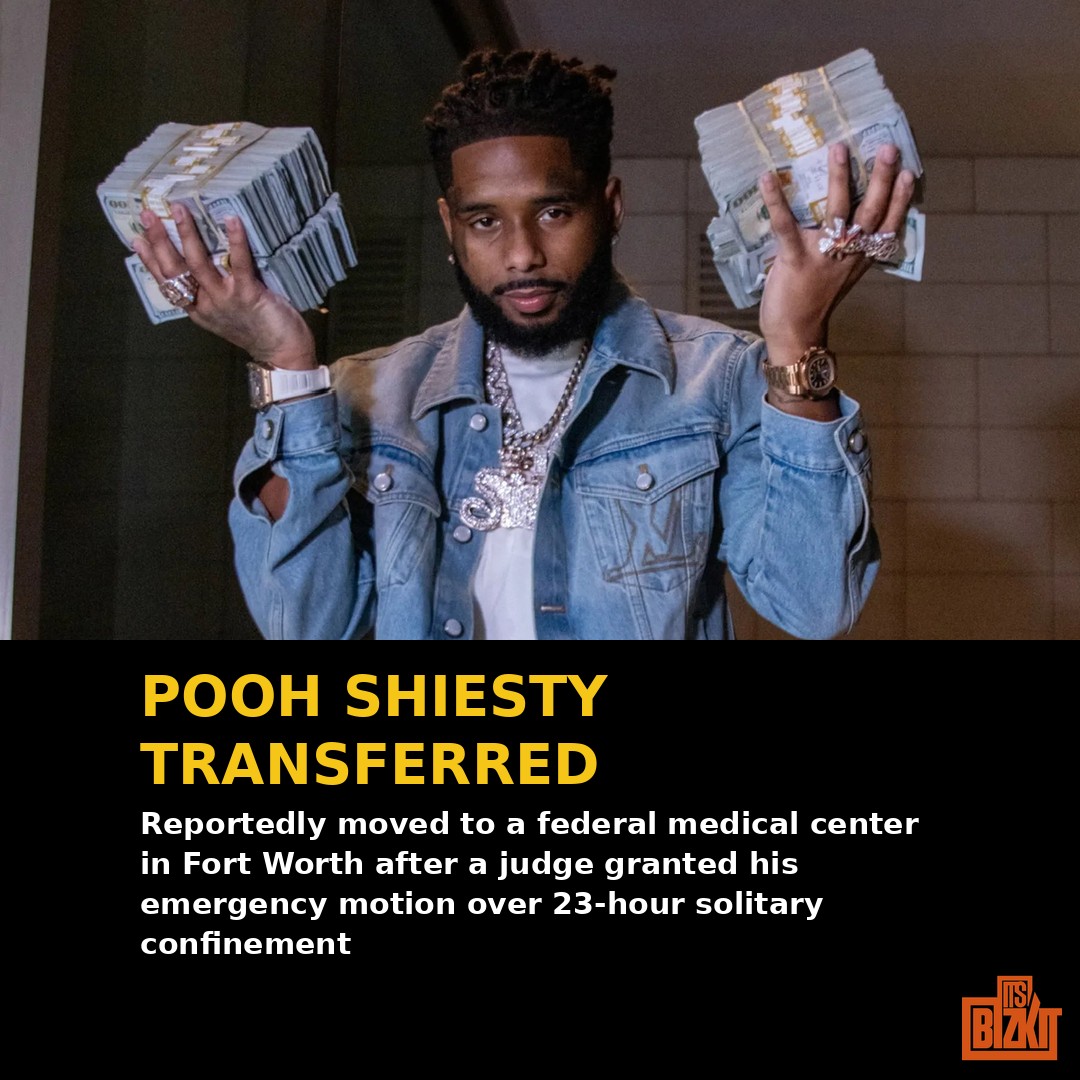
Pooh Shiesty Reportedly Transferred to Federal Medical Center After Judge Acts on Solitary Confinement Claims

Pooh Shiesty is reportedly on the move. The Memphis rapper, born Lontrell Williams Jr., has been transferred out of the Texas jail where his attorney says he spent months locked in his cell 23 hours a day, with multiple reports on Thursday placing him at a federal medical center in Fort Worth. The Pooh Shiesty transfer reports follow a federal judge’s decision last week granting his legal team’s emergency motion over the conditions of his confinement.
The Pooh Shiesty Transfer Reports
The reported destination is FMC Fort Worth, an administrative-security federal medical center with a detention center. The reports surfaced Thursday, November 19, as photos circulated showing Williams in an orange jumpsuit being escorted by Bureau of Prisons officers outside a building marked “Medical Center.” Neither the Bureau of Prisons nor the court has publicly confirmed the destination, and Daily Loud, which reported the transfer Thursday afternoon, noted that his transfer date and destination have not yet been confirmed. What is confirmed: Williams is not being released. He remains in federal custody awaiting trial.
His Attorney Says Solitary Cost Him 30 Pounds
The transfer fight went public this week through Williams’ attorney, Kent Schaffer, who detailed the conditions at Rolling Plains Regional Jail in Haskell, Texas, in an interview with KTXS News published Tuesday, November 17. Schaffer said Williams was placed in solitary confinement the moment he arrived at Rolling Plains in July, locked down 23 hours a day with contact limited to short video visits on an iPad, and that officials told him it was for his own protection — an explanation the attorney rejects. The claims below are Schaffer’s, made on his client’s behalf; the jail did not respond to KTXS.
“His sleep patterns were way off. He had lost about 30 pounds.”
“It was just mentally wearing him down because he has no contact with people other than through an iPad in short bursts of video visits.”
Schaffer also challenged the visitation setup, saying Williams’ family makes an 18-hour round trip from Memphis for an hour-long visit twice a month.
“The U.S. Marshals Office has a written protocol that they follow in terms of how much visitation you get. In reality, it wasn’t being followed.”
According to Schaffer, the trouble started at the Kaufman County Detention Center, where officials claimed Williams engaged in misconduct on a jail-issued tablet.
“They claimed that he engaged in some sort of misconduct on the tablet, so they moved him to a different facility rather than just taking the tablet away. They transferred him to Rolling Plains back in July. As soon as he arrived in Haskell, they immediately put him in solitary confinement. They said that it was for his own protection. I don’t think it was about safety at all. I think that’s the excuse they’ve given.”
Prosecutors have pushed back on the defense’s account. In an October 20 court filing, U.S. Attorney Ryan Raybould argued the conditions were not inhumane, said the separation was for Williams’ own safety after inmates tried to reach his cell area for autographs, and pointed to tablet records showing hundreds of video visits and thousands of emails since July. ITSBIZKIT laid out both sides when the case was argued earlier this month.
How the Judge Ruled
Williams’ legal team filed the emergency motion on October 15, arguing the isolation was not tied to any significant disciplinary history and was damaging his sleep and mental state. At a hearing in Dallas on Tuesday, November 10, the two sides agreed on the motion in front of U.S. District Judge David C. Godbey — the court record states “the parties have agreed on the motion and will inform the court if they are unable to secure a suitable location for the defendant.” In an earlier ruling in the dispute, Judge Godbey wrote that Williams reported the restrictive incarceration “already is adversely affecting his sleep and his mental state,” and that continuing it without documented justification “risks converting his pretrial detention into something tantamount to unconstitutional punishment.” On November 12, Williams’ previous attorney, Bradford Cohen, posted that the rapper was out of solitary:
“Pooh Shiesty is finally out of solitary. Isolating a man who hasn’t been convicted of anything is punishment before trial. He’s presumed innocent, and the government still hasn’t explained the holes in its case. February can’t come soon enough.”
The Case Still Ahead of Him
Williams, 27, has pleaded not guilty to federal robbery and kidnapping charges tied to what prosecutors describe as a January 10, 2026 incident at a Dallas recording studio involving Gucci Mane. He was arrested in April and has been held without bond. His trial is scheduled for February 22, 2027, in federal court in Dallas. The confinement fight was never about guilt or innocence — it decided where, and how, he waits for that trial.
The move, if the Fort Worth reports hold up, closes the chapter his lawyers opened in October. Whether the new facility ends the dispute or just relocates it is the next thing to watch.
More stories like this at ITSBIZKIT.
Source: KTXS News’ interview with defense attorney Kent Schaffer, published November 17, 2026, as reported by XXL; WFAA’s reporting of the November 10 court agreement; transfer reports via Daily Loud and MyMixtapez, November 19, 2026 (destination not yet officially confirmed). Photo: Pooh Shiesty, via Daily Loud.