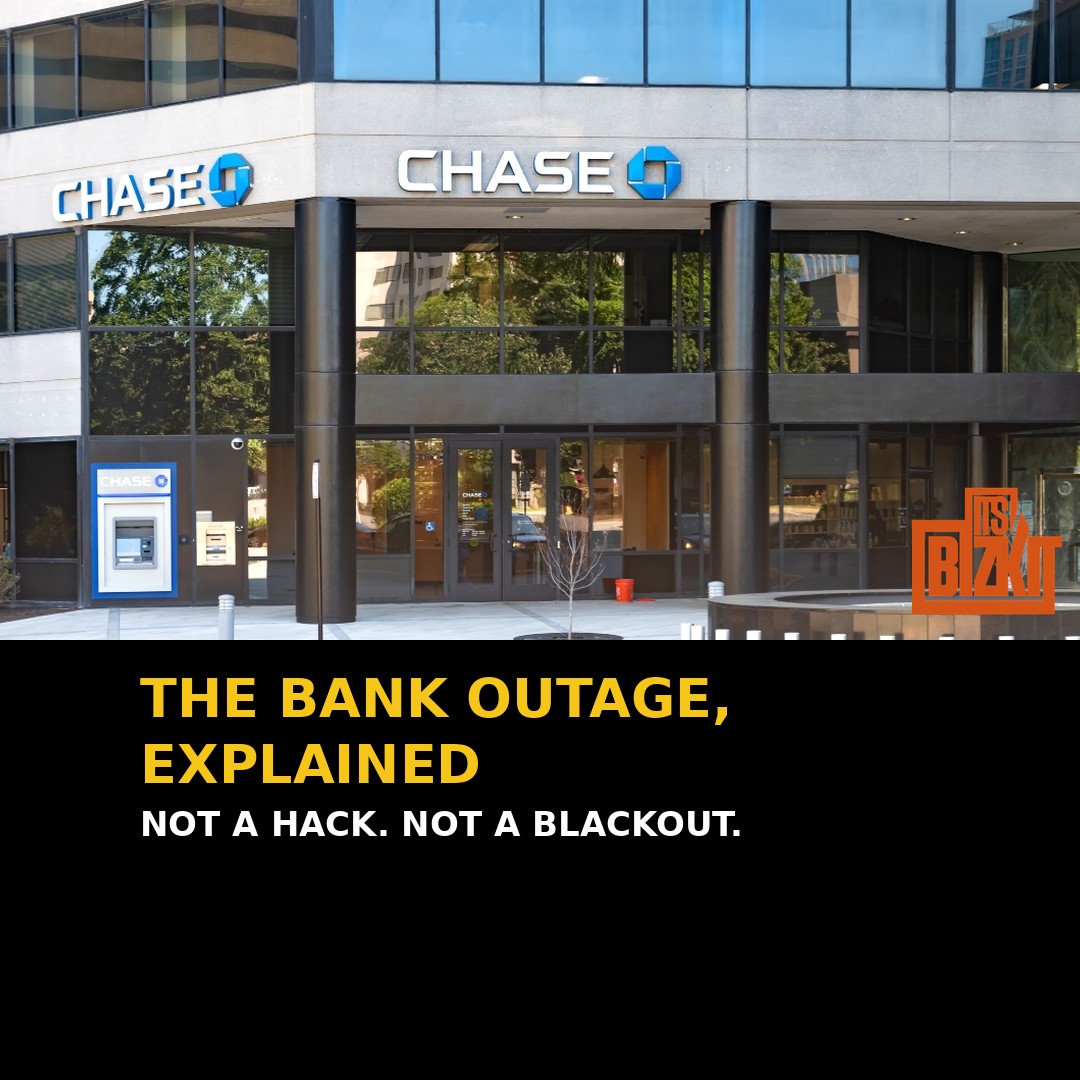
The Bank Outage, Explained: What Really Happened at Chase, Wells Fargo and Bank of America — And Why the Blackout Talk Is False
If your money was moving funny yesterday, you weren’t tripping — but the internet was lying to you about why. Here is the bank outage explained, start to finish.
On Monday (Nov 16), customers at Chase, Wells Fargo and Bank of America spent most of the day staring at accounts they couldn’t get into, balances that looked wrong, and transfers and Zelle payments stuck in limbo. Reports started rolling in around 9:30–9:53 AM ET and peaked around 2 PM, with close to 4,800 people reporting problems with Chase alone on Downdetector. The culture pages ran the panic version of the story. Here’s the verified one.
WHAT ACTUALLY HAPPENED
The problem started at JPMorgan Chase — the biggest bank in the country. Chase confirmed the disruption was “a temporary issue related to a software bug in on-premise hardware systems.” In plain English: a bug in Chase’s own machines slowed down its transaction processing. Chase was direct about the two things everybody was scared of: there is no evidence it was cyber related, and “this is not a systemic issue.”
That’s why customers at other banks felt it too. Chase said other banks were only slowed on transactions that involved Chase — so if a Wells Fargo or Bank of America payment was going to or from a Chase account, it got stuck in the same traffic jam. Bank of America told reporters its own systems were operating normally. Wells Fargo posted a notice that online banking was temporarily unavailable, then took it down as things cleared. And the Federal Reserve’s payment systems — Fedwire, FedACH and FedNow — ran normally the entire time.
WHY YOUR ZELLE WAS LATE
Zelle’s operator, Early Warning, said the Zelle network itself was normal. The delays were on payments moving to or from Chase accounts. So if your Zelle sat pending yesterday, it wasn’t lost — it was in line behind Chase’s bug, same as everybody else’s money.
WHERE IT STANDS NOW
With the bank outage explained, here is where things stand now. By about 6:30–7 PM ET Monday, Chase confirmed transactions were processing normally again, and by Tuesday morning (Nov 17) outage reports were back down to normal levels everywhere. DHS Secretary Mullin said Monday night that DHS does not believe it was a cyberattack. No bank is down today. Your money was never gone — it was delayed.
THE BLACKOUT TALK IS FALSE
The scariest posts making the rounds claim a “global cyberattack” lands today, Nov 17, with a 90-day blackout behind it. That rumor traces back to an anonymous post with no named source, and no agency — not CISA, not the Fed, not the FDIC — has confirmed or warned about anything like it. There is nothing behind it.
One thing that IS real today: at 2:20 PM ET, a nationwide Emergency Alert System message goes out on TV and radio. That’s a scheduled TEST, announced back on September 16, 2026 — phones aren’t even part of it. If the alert crosses your screen today, it’s a drill, not the start of anything.
Bottom line: Monday was one bank’s software bug casting a long shadow, not an attack on the whole system. The money was moving again by Monday night. Don’t let a panic post finish what a software bug couldn’t.
Source: Chase statements to USA TODAY, AP and NBC News; DHS remarks (Nov 16, 2026).