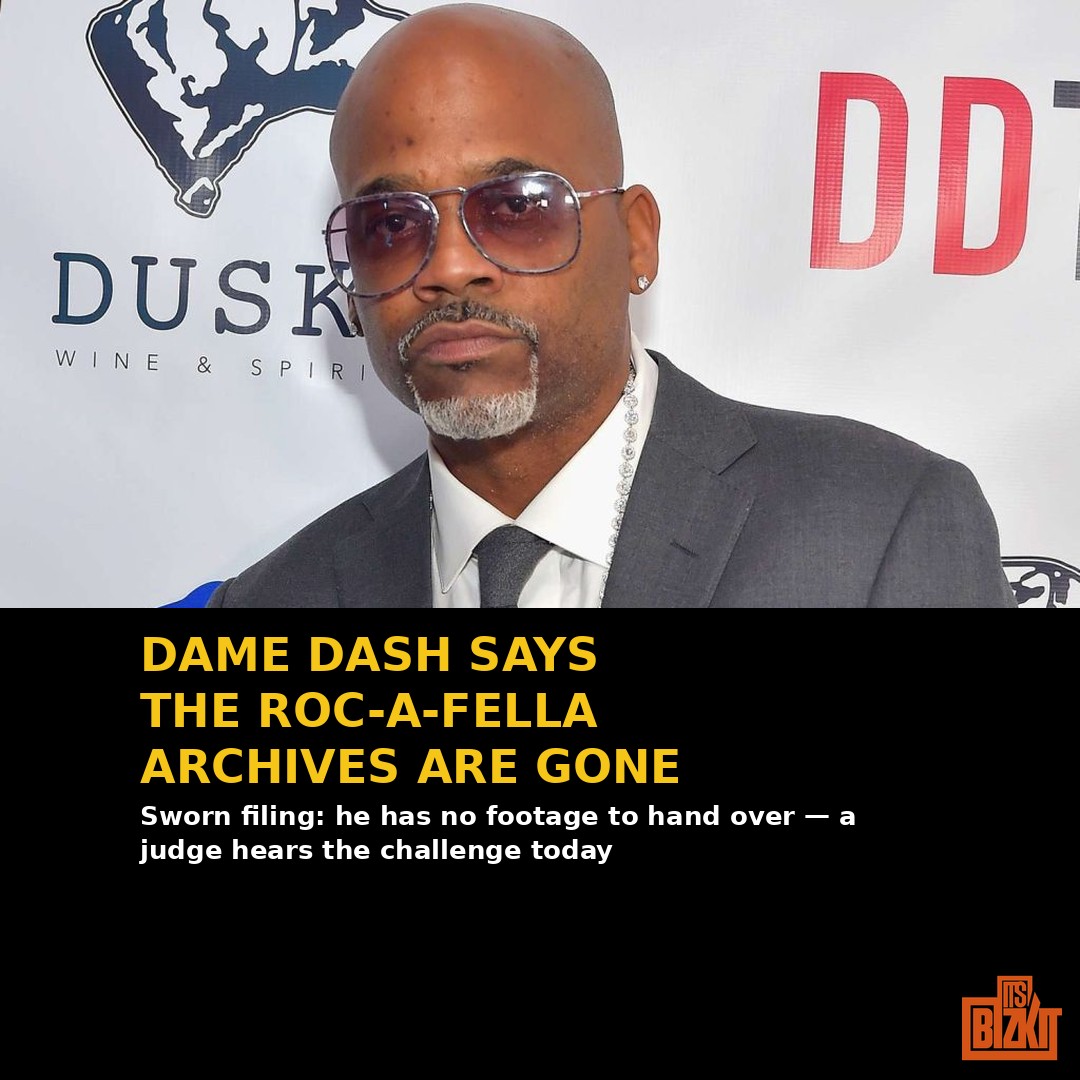
Dame Dash Tells Bankruptcy Court He Has No Roc-A-Fella Archives to Turn Over
Dame Dash built Roc-A-Fella on one word: ownership. In a sworn statement filed Tuesday, November 17, in his Florida bankruptcy case, Dash declared that he “does not possess any archival material relating to his life and career” — one day after the deadline to hand over 100-plus hours of video, photographs, memorabilia and an unfinished Roc-A-Fella documentary to Everlasting Films came and went. ITSBIZKIT covered the order when the court gave Dash seven days to surrender the archives.
What the Filing Actually Says
Dash’s statement, reported by Complex and HotNewHipHop, does not claim the archive never existed — only that it is not his to give. “In the event any of the Archival Materials do exist they are not in the possession, custody or control of the Debtor,” he wrote. His explanations came in two parts. First: “To the extent that the Debtor had possession, custody or control of any Archival Materials, they would have been located in all of his storage units that were all auctioned off in 2017.” Second: around 2005, he gave his children — minors at the time — personal items that “might technically constitute Archival Materials.” “It is now nearly 22 years later,” he wrote, “and any such items were not my property as of the date I filed this bankruptcy case.” The filing also acknowledged a Simon & Schuster book deal missing from his paperwork.
How His Life Story Got Sold
The archive fight caps a long collapse. Filmmaker Josh Webber’s Muddy Water Pictures won a judgment against Dash over the film Honor Up, and attorney Christopher Brown — who represented Webber in the chase and won a defamation judgment of his own against Dash — spent years coming for his assets. Dash filed Chapter 7 on September 4, 2025, reporting roughly $25.3 million in liabilities against just $4,350 in personal assets. Trustee Traci K. Stevenson moved to sell what was left, and on October 1, Everlasting Films won his life-story rights for $550,000, beating Doug Peters’ $500,000 backup bid — with Brown, his longtime courtroom nemesis, helping finance the winning bid, as AllHipHop reported. The sale covers his life through the filing date and excludes the Roc-A-Fella music catalog. On November 10, the court ordered delivery within seven days — originals, digital files, metadata, plus names of anyone else holding material — and barred Dash from destroying, concealing or transferring any of it.
Today’s Hearing — and the Problem With His Story
A hearing is set for Thursday afternoon, where Stevenson’s side is expected to challenge the claim; her attorney had no comment on the filing. Dash’s problem is that the footage was never a secret. Director Adam Bhala Lough revealed this year that Dash asked him to direct the official Roc-A-Fella documentary, describing Dash as “sitting on 100s of hours of incredible footage from that era.” Lough passed because Dash refused to include Jay-Z’s side of the story. The trustee’s side flagged the same 100-plus hours back in August, and nobody disputed it then. If the court decides the archive exists and Dash is stalling, it has enforcement tools — and the undisclosed book deal gives the trustee reason to ask what else went unreported.
What “Gone” Means for Roc-A-Fella History
The Roc-A-Fella vault is bigger than one bankruptcy case: it is the raw tape of an era — the label that launched Jay-Z, Kanye West, Cam’ron and Beanie Sigel, filmed from inside by its co-founder. If Dash’s account is true, that history was scattered to storage-unit buyers in 2017 or handed to his children two decades ago, and the documentary Everlasting Films paid $550,000 to make lost its raw material. If it is not true, the most complete visual record of the Roc’s rise sits somewhere its owner would rather fight a bankruptcy court than surrender.
More stories like this at ITSBIZKIT.
Source: Complex (report on Dash’s November 17, 2026 sworn statement) and HotNewHipHop; AllHipHop reporting on the life-rights auction. Photo via Gang Flow.